Munnar, Kerala
Picking the first flush before the mist lifts.
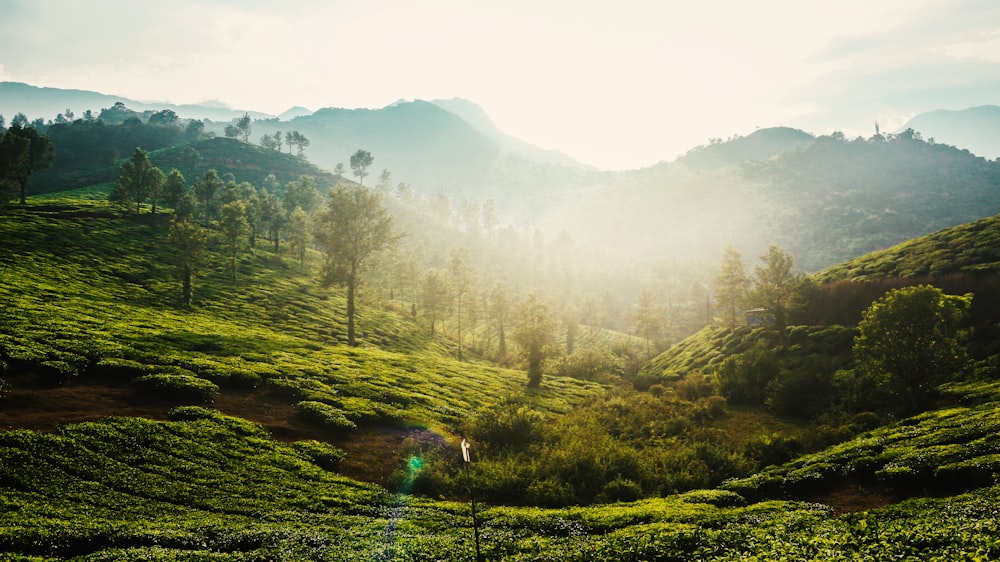
On a small estate above Munnar, the first pluck of the season starts at five-forty and ends when the sun hits the slope. Everything about the tea depends on that window.
You are woken by the sound of people walking past your window in the dark, which is the entire point of staying on the estate rather than in town. At five-forty a line of women goes up the path with baskets and plastic sheeting over their shoulders, and if you are dressed and outside by then you can walk up behind them. Nobody makes an event of this. Nobody has been assigned to you.
The first flush is the season's first growth after the cold months, and on a high-grown Nilgiri slope it is the tea everything else is judged against. Two leaves and a bud, taken by hand, and the fineness of the pluck is the whole difference between a lot that sells and a lot that gets blended into something anonymous. Rekha, who has been on this slope for twenty-two years, plucks at a speed I could not follow with my eyes and talked to me the entire time without once looking at her hands.
The mist is not weather here. It is a deadline.
The reason it happens before dawn is moisture. The leaf comes in cool and turgid with the night's condensation still on the bush, and it goes to the factory in that state. Once the sun is on the slope the leaf loses water, the pluck gets coarse, and — more immediately — the picker is working an exposed hillside at nineteen hundred metres with no shade. By half past nine the mist has burned off the ridge and the line comes down. “The mist is not weather here,” the field supervisor said. “It is a deadline.”
The estate is forty hectares, small enough that the owner knows every name on the line, and it sells to a single buyer in Kochi plus a small quantity it processes itself in an orthodox rolling shed that was installed in 1974 and is operated by a man who talks to it. I was shown the withering troughs, the roller, the drying chamber, and a tasting table with eleven cups laid out from that week's lots. I was allowed to taste all eleven and could confidently distinguish about four.
There is a version of tea tourism in Munnar that involves a bus, a viewpoint, a museum and a gift shop, and it is entirely reasonable if that is your day. What staying on a working estate gives you instead is the thing the bus cannot: the sound of a line moving through the bushes above you at six in the morning while it is still too dark to photograph, and the understanding that this happens two hundred and some days a year and has nothing to do with you.
Two rooms in the old planter's bungalow, which is draughty and enormous and has a fireplace laid every evening whether or not it is needed. Meals are Kerala home food — appam, ishtu, a fish curry if someone has been to Marayoor. The house is at eighteen hundred metres and it gets to nine or ten degrees at night in March, which nobody from Kerala ever quite believes until they are there.
Somewhere like this?
We list a small number of homes across all seven terrains, from the Himalayas to the cities. Every home is chosen by a person, not an algorithm — pick your dates, pay once, and the stay is confirmed on the spot.