Khavda, Kutch, Gujarat
The potter's wheel in the salt flats of Kutch.
The clay comes from a lake that is only a lake for six weeks a year, and the man who digs it can name the three years it did not appear at all.
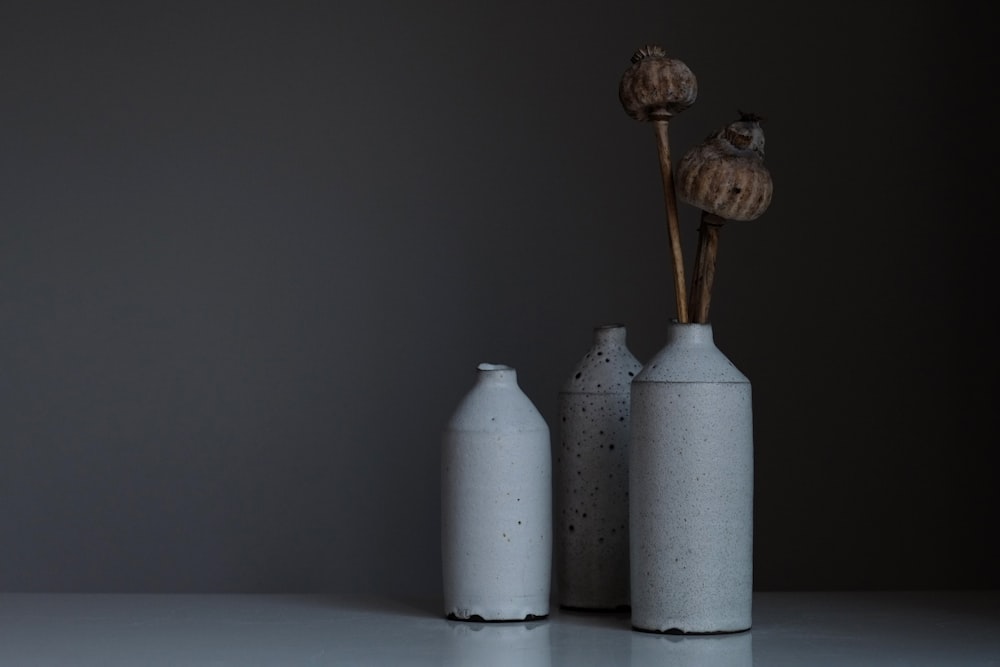
Khavda is the last real village before the Rann, an hour and a half north of Bhuj on a road that ends, effectively, at the border. It has been a pottery village for as long as anyone can document, and the reason is geological rather than cultural: there is a depression eight kilometres out that fills during the monsoon and holds a fine grey clay that behaves, on a wheel, in a way the local potters describe as obedient.
Ismail Bhai took me out to it in January, when it is a cracked pan of nothing. He walked to a spot that looked identical to every other spot, put a foot on it, and said this is where. He digs once a year, after the water goes, and carts back enough for the year in a trailer. If the rain is bad there is less. He named 1999, 2002 and 2018 as years the depression did not fill properly, in the way another man would name a bereavement.
The clay comes from a lake that is only a lake for six weeks a year.
The wheel is a heavy stone disc, turned by hand with a stick and then left to run on its own momentum, which is a fundamentally different instrument from the kick wheel or the electric one. There is no continuous power. You get maybe forty seconds of usable rotation, decelerating the whole time, and then you stop and spin it again. Watching him centre a lump of clay in about four seconds on a wheel that is already slowing down was the single most impressive piece of craft I saw in a week in Kutch.
The decoration is done by his wife, Hawa Ben, and by their daughter-in-law, in three colours — the red from a local ochre, a white from a clay slip, and black — applied freehand with a squirrel-hair brush in patterns that are geometric, dense, and completely unhesitant. No sketching. No template. I watched her band a water pot from lip to base in under ten minutes with the pot balanced on her knee.
What is fragile here is not the skill; it is the market. These are, historically, water pots, storage jars and lamps, and Khavda's customers were the villages around it. Plastic ended that and nobody in the family pretends otherwise. What has replaced it is a mix of design commissions, a co-operative that sells into Ahmedabad and Bombay, and visitors, and the third of those is the one they are most ambivalent about. Ismail Bhai will happily sit you down at the wheel. He is markedly less happy about the people who arrive, photograph him for eleven minutes, buy nothing and leave, and there were two such carloads while I was there.
I stayed two nights in a bhunga — the round, thick-walled, thatched Kutchi house, which is cool in a way that no amount of engineering has improved on — in a family compound at the edge of the village, with a charpoy outside the door and a sky that is, this being sixty kilometres from anything, absurd. Dinner was bajra rotla, a garlic and chilli chutney, buttermilk, and a vegetable that changed each night.
On the second afternoon he fired a small kiln — a pit, essentially, of dung cake and dry brush, brought up slowly over several hours. He does not use a pyrometer. He judges it by the colour through a gap in the top and by how long it has been since he last fed it. Everything came out. He said, unprompted, that some years he loses a quarter of a firing, and that his father lost more, and that this is simply the arrangement one has with fire.
Somewhere like this?
We list a small number of homes across all seven terrains, from the Himalayas to the cities. Every home is chosen by a person, not an algorithm — pick your dates, pay once, and the stay is confirmed on the spot.