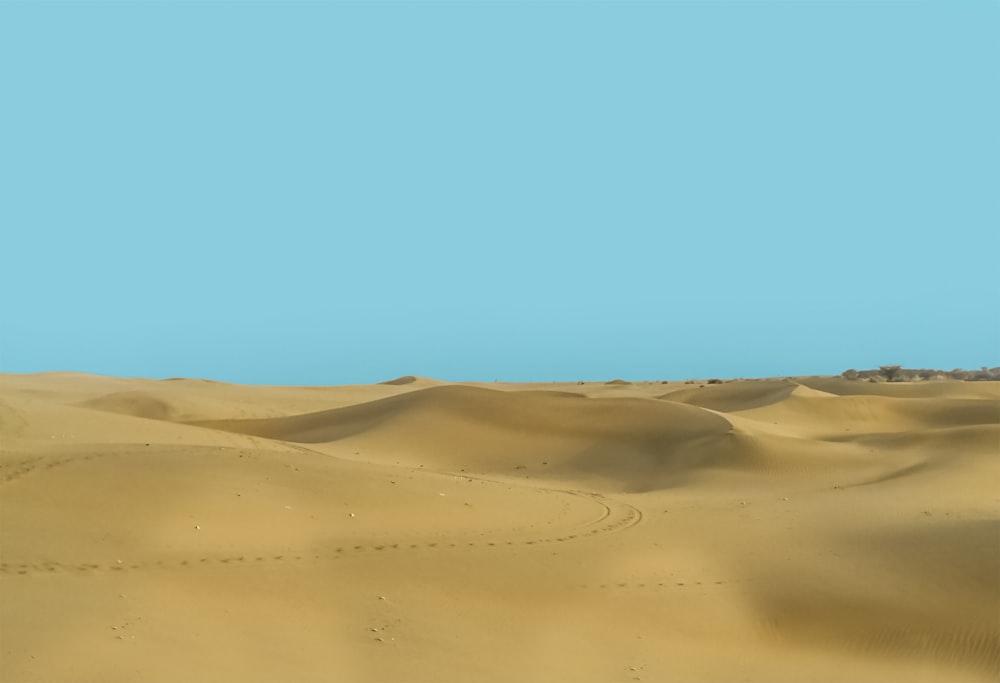
Khuri, Rajasthan
One night in the Thar, scored by a folk musician.
Forty kilometres from Jaisalmer, a Manganiyar musician plays for six people and no microphone — and spends the interval explaining why the songs are not, in fact, about the desert.

There is an industry version of this evening and you have probably seen a photograph of it: a hundred people on cushions, a floodlit dune, a buffet, a man in a turban being photographed rather than listened to. Khuri has that too, in three or four places, and it is not what I went for. I went because a friend in Jodhpur gave me a phone number and said the words “only six people” twice.
The camp is four tents and a low mud building on the far side of the village, run by Bhikaram and his two sons. The tents are canvas over a wooden frame, with proper beds and a bucket for washing and a paraffin lamp each. There is a generator that runs for two hours in the evening and is then, mercifully, switched off. Dinner is at the mud building: ker sangri, bajra roti cooked on an open fire and finished directly in the embers, garlic chutney of a ferocity I was not prepared for, and as much buttermilk as you can drink.
He tuned the kamaicha to the wind, which I had assumed was a figure of speech.
Sattar Khan arrived at eight, on a motorcycle, with a kamaicha in a cloth bag. He is Manganiyar — the hereditary musician caste of western Rajasthan, Muslim by faith, whose patrons for four centuries were Hindu Rajput families, and who carry a repertoire that is genealogy as much as it is music. He is fifty-one. He has played in Paris and in Berkeley, and he plays here perhaps thirty nights a season for whoever Bhikaram tells him is coming.
He sat down on the sand, took out the instrument, and spent a long time doing nothing that looked like tuning. The kamaicha is a bowed lute with a hemispherical body covered in goatskin, and it is loud in a way that surprises you outdoors. He turned it, played two notes, turned again, moved his shoulder into the wind. “He tunes it to the wind,” Bhikaram said, and I wrote that down as a nice line, and then over the next twenty minutes I realised it was a technical description. The skin head slackens as the temperature drops. He was tracking it.
The first song was long and I understood none of the words. The second, he explained afterwards, was about a woman waiting for a man who is away trading in Sindh. The third was a wedding song, though not a happy one. In the interval he said something that reorganised the whole evening for me: that almost none of it is about the desert. Foreigners always assume the songs are about sand and camels and distance. They are about absence, credit, rain that did or did not come, and a very specific set of families. “The desert is where we are,” he said. “It is not what we are singing about.”
By eleven the generator was off and the only light was the fire and an almost violent quantity of stars. Six of us, one musician, one drummer who had appeared from somewhere with a dholak, and no amplification of any kind. This is the part I cannot really convey. Sound behaves differently on open sand — it does not come back to you. There is no room, no reflection, nothing for the note to bounce off. Every phrase goes out and simply stops existing. It makes you listen with an attention I did not know I was capable of, because nothing is repeated and nothing lingers.
I asked Sattar Khan, at the end, how he decides what to play. He said he watches who has stopped talking. That is the entire method. He played for a little over two hours for six people, packed the kamaicha into its cloth bag, took a cup of tea, and rode the motorcycle back to the village at half past midnight with no headlight to speak of.
Bhikaram takes bookings by phone, in Hindi, and writes them in a notebook. When I asked how people find him he said, with genuine puzzlement at the question, that people tell other people. I am aware of the irony of writing that down. But there is a real risk in the other direction too: a musician of that standing playing to a hundred people over a PA, for a fee that has been decided by someone who has never heard him, is how a tradition becomes a floor show. Six people, no microphone, and an interval long enough for a conversation is not nostalgia. It is just the arrangement in which the music still works.
Somewhere like this?
We list a small number of homes across all seven terrains, from the Himalayas to the cities. Every home is chosen by a person, not an algorithm — pick your dates, pay once, and the stay is confirmed on the spot.